


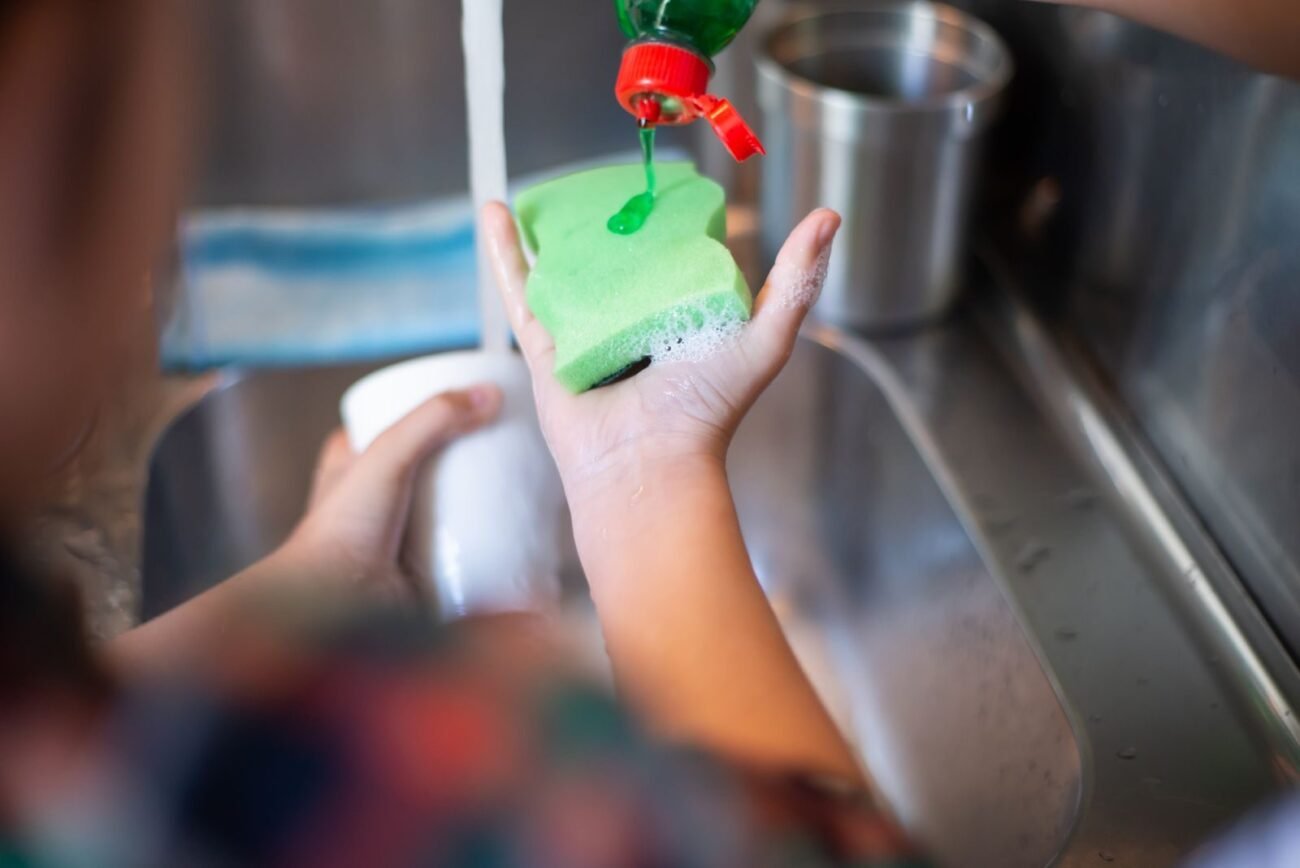
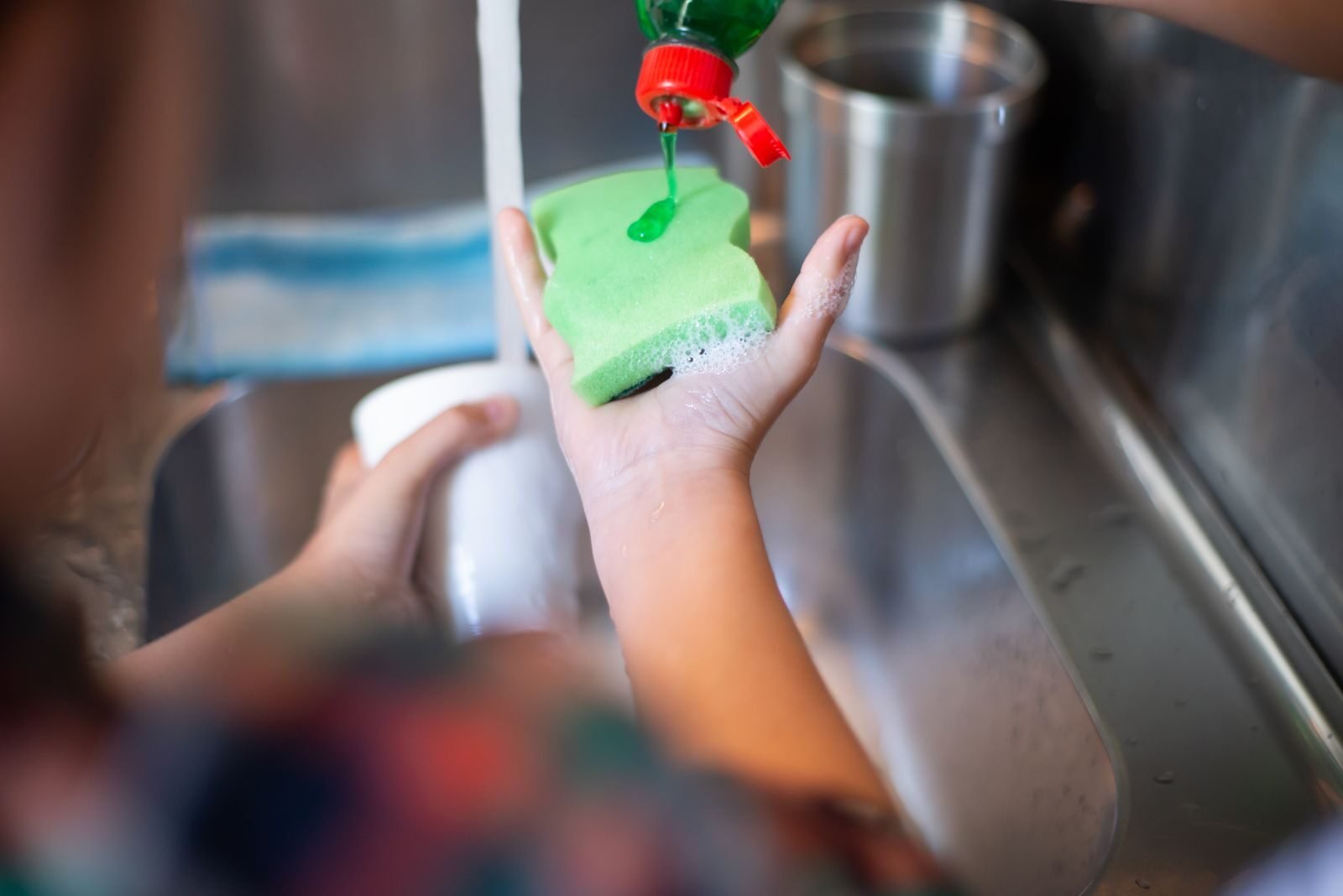
You squeeze it out every single day, watch it foam up over the plates, and then rinse it away without a second thought.
But is dish soap biodegradable, and where does it actually go once it disappears down that plughole?
I get this question a lot, and I understand why. Dish soap is one of the few cleaning products that we knowingly pour into water and send off into the drains, so it feels like the one most likely to end up in a river somewhere. The answer is mostly reassuring, with a couple of caveats worth knowing.
Let me walk you through it the way I think about it.
Part of my postgraduate work was in ecotoxicology and risk assessment, which is the study of how substances affect living things and the wider environment, and at what dose they start to count.
So when someone asks me if dish soap is biodegradable, I do not just want a yes or no. I want to know what breaks down, how fast, and whether anything harmful is left behind on the way. That is the useful version of the answer.
What is in dish soap
Before we can ask whether it breaks down, it helps to know what “it” is.
The ingredient doing the real work in dish soap is a group of chemicals called surfactants. A surfactant is a clever molecule with two ends: one end likes water, the other likes grease. That split personality is what lets it surround the fat and food on your plates, lift it off, and hold it in the rinse water so it washes away. Every foaming cleaner you own relies on surfactants.
Most of the rest of the bottle is water, plus small amounts of things like thickeners, fragrance, preservatives, and often a little salt. But the surfactants are the part that counts most for this question, because they are the ingredient present in the largest active amount, and the ingredient that ends up in the waste water. So when we ask “is dish soap biodegradable,” we are really asking whether those surfactants break down.
So is dish soap biodegradable?
For most ordinary dish soap, the answer is yes, the surfactants are biodegradable, and this is not just a marketing hope. It is built into the law in many places.
Here is the part I find reassuring as someone trained to look at exactly this. The surfactants used in household detergents are required to break down, and there is a defined test they must pass. Under the standard used across the European Union, a surfactant only counts as biodegradable if at least 60 percent of it breaks down within 28 days in a controlled test. That is what the word is supposed to mean: not “will vanish one day,” but “measurably gone, to a set level, within a set time.” A number and a deadline, which is exactly what I want to see behind any claim.
So the surfactants in a normal bottle of dish soap are designed and required to be broken down by the microbes in sewage treatment and in the environment. They are food for bacteria, which take them apart into simpler, harmless things. That is genuinely good news, and it is why I do not lie awake worrying about my washing-up water.
The part the label does not tell you: down the drain is different
Now the caveat, because “biodegradable” is only half the story, and this is where my training makes me push a bit further.
The United States Environmental Protection Agency makes a point I think everyone should know. It notes that biodegradability is a special concern for products that go down the drain, because these can be toxic in the water environment, and that a proper assessment has to look at aquatic toxicity as well as whether the thing breaks down. In other words, two separate questions count. Does it break down? And while it is still around, does it harm life in the water?
This is the bit that “biodegradable” on the front of a bottle quietly skips. A surfactant can be perfectly biodegradable and still be hard on fish or aquatic insects if it reaches them at a high enough concentration before it breaks down. Biodegradable tells you about the eventual disappearing act. It does not, on its own, tell you about the harm done in the meantime. Both need checking, which is why the better eco standards screen for both.
The reassuring reality for most of us is that dish water from a home is heavily diluted and usually goes to a sewage treatment plant, where the surfactants are broken down before the water is released. The concentration reaching any actual river is normally very low. The dose, as ever, is what decides the harm, and a squirt of washing-up liquid in a full sink, sent to treatment, is a very different thing from tipping neat soap straight into a stream.
Not all surfactants are equal
One more layer, because I would rather give you the honest, complete picture than a tidy myth.
The common surfactants in everyday dish soap, the anionic ones, are generally the well-behaved kind: readily biodegradable and low risk at normal use. But surfactants are a family, not a single thing, and some relatives behave worse. Certain other types are more toxic to water life, and a few older ingredients were a real problem because their breakdown products lingered and caused harm of their own.
The industry has moved away from most of those, but it is a good reminder that “it is a surfactant” is not automatically “it is fine.” The specific one counts.
This is also why I gently ignore the word “biodegradable” splashed across a label and look instead for whether a product actually meets a recognised environmental standard. A real standard checks the specific ingredients, their breakdown, and their effect on aquatic life. The word alone, with nothing behind it, is doing more for the brand than for the river.
How I choose and use dish soap
So here is what I do, and what I would suggest, based on all of the above rather than on the label’s promises.
I do not stress about ordinary dish soap harming the planet through my sink, because the surfactants are biodegradable, the amount is small, and the water is treated. If you want to go a step further, look for a product that names a real environmental certification rather than one that just prints the word “biodegradable,” because the certification is the part that has actually been checked.
And use a sensible amount. This is the ecotoxicology habit again: more soap is not more clean, it is just more surfactant heading down the drain for no extra benefit. A small squeeze does the job. Using less is better for the water and for your wallet, and it is the simplest green choice you can make with the bottle you already own.
That is the whole picture. Dish soap is largely biodegradable, the real question is what it does in the water before it breaks down, and for a normal home the answer is not much. Use a little, rinse, and you can stop worrying about the plughole.
Summary
The cleaning power in dish soap comes from surfactants, molecules that grab grease and lift it into the rinse water. Since those surfactants are the part that goes down the drain, they are what the biodegradability question is really about.
For most ordinary dish soap the surfactants are biodegradable, and in many places this is required by law, with a defined test: a surfactant counts as biodegradable only if at least 60 percent breaks down within 28 days. So “biodegradable” should mean a measured amount gone within a set time, not a vague promise.
Biodegradable is only half the story, though. Products that go down the drain also have to be judged on aquatic toxicity, because a substance can break down and still harm water life while it is present. For a normal home the dish water is heavily diluted and usually treated before release, so the concentration reaching rivers is low.
The common surfactants in everyday dish soap are the well-behaved, readily biodegradable kind, though not all surfactants are equal, which is why a real environmental certification is worth more than the word alone. Using a small amount is the simplest way to keep the impact low.
Common questions
Is dish soap biodegradable?
For most ordinary dish soap, yes. The surfactants that do the cleaning are generally biodegradable, and in many regions detergent surfactants are legally required to break down to a set level within a set time. The bigger question is what the product does to water life before it breaks down, which is why a genuine environmental certification tells you more than the word “biodegradable” alone.
Is Dawn dish soap biodegradable?
The surfactants in common dish soaps like Dawn are generally of the readily biodegradable type used across the industry. What I would look at is not the brand name but whether a product meets a recognised environmental standard, since that is the part that has actually been tested for both breakdown and effect on aquatic life. The word on the front is not evidence on its own.
Does dish soap harm rivers and fish?
At normal home use, the risk is low. Dish water is heavily diluted and usually goes to a sewage treatment plant, where the surfactants are broken down before the water is released, so very little reaches any river. Harm depends on concentration, and a small amount of soap sent to treatment is very different from pouring neat soap into a stream.
What does “biodegradable” really mean on dish soap?
It should mean the ingredient breaks down to a defined level within a defined time. Under the standard used across the European Union, a surfactant counts as biodegradable only if at least 60 percent breaks down within 28 days in a controlled test. A bare “biodegradable” with no standard behind it is a marketing word, so a recognised certification is the stronger sign.
How can I make my dish washing more eco-friendly?
Use less soap, since more does not clean better and only sends extra surfactant down the drain. Choose a product that names a real environmental certification rather than one that just prints “biodegradable.” And do not tip neat soap outdoors or into drains that bypass treatment. For everyday washing up, a small squeeze and a normal rinse is already a low-impact choice.